
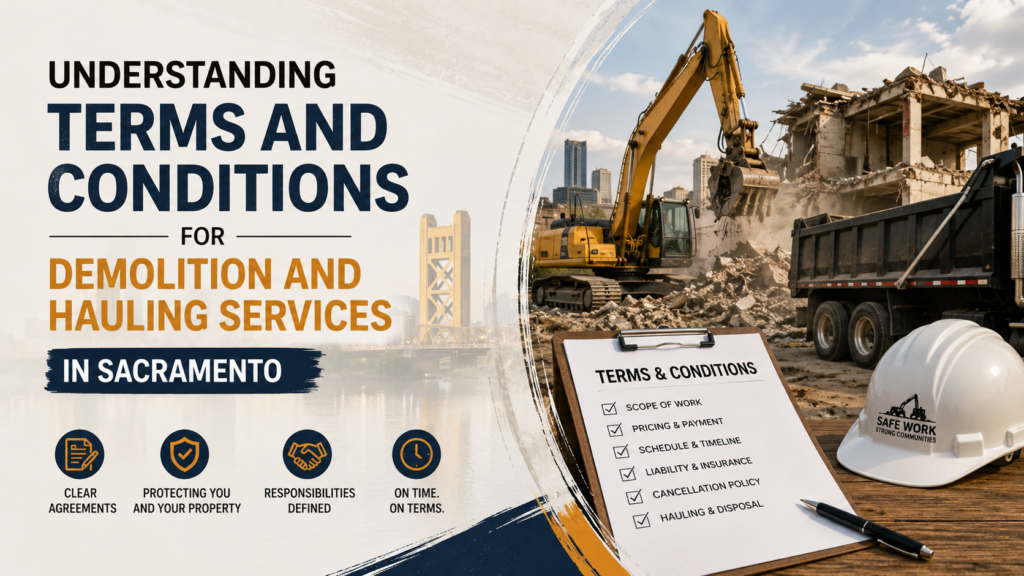
When engaging any professional contractor particularly in high-risk industries like demolition and hauling understanding the contractual framework that governs the relationship is essential for protecting all parties. Terms & Conditions Empire Demolition and Hauling documents serve as the foundational agreement between service providers and their clients, defining rights, responsibilities, limitations, and expectations before any work begins. This article explains what construction and demolition service terms and conditions typically cover and why they matter for anyone working with demolition companies in Sacramento.
Why Terms and Conditions Matter in Demolition Services
Demolition and hauling projects carry inherent risks physical hazards, potential for property damage, exposure to hazardous materials, regulatory compliance requirements, and significant financial investment. Terms and conditions exist to clearly define how these risks are allocated between the contractor and the client, and to establish a framework for resolving disagreements should they arise.
A well-structured terms and conditions document also sets realistic expectations before work begins. Clients who understand the scope of what they are agreeing to including what the contractor will and will not be responsible for, how changes to scope are handled, and what payment terms apply are better positioned to make informed decisions and to have a positive project experience.
Common Elements in Demolition Service Agreements
Scope of work definition is the starting point for any demolition contract. The terms establish precisely what work will be performed, what structures or materials will be demolished or removed, and what is excluded from the agreement. Clear scope definition prevents misunderstandings about what the contractor is expected to do and what falls outside the agreed scope.
Payment terms specify when and how payment is due. Construction contracts typically involve payment schedules tied to project milestones an initial deposit upon execution, progress payments as work proceeds, and a final payment upon completion. Terms may also address what happens in the event of late payment, including potential project pauses or late fees.
Change order procedures establish how modifications to the agreed scope of work are handled. Demolition projects frequently encounter unforeseen conditions unexpected hazardous materials, buried structures not visible during the initial assessment, utility conflicts that require additional work beyond the original scope. Terms and conditions should address how these situations are identified, priced, and authorized before additional work proceeds.
Permit and regulatory responsibilities clarify which party contractor or client is responsible for obtaining permits and ensuring regulatory compliance. In Sacramento, demolition projects require permits from the city or county, and hazardous material abatement requires additional certifications and notification processes. Typically the contractor manages these on behalf of the client, but the terms should make this explicit.
Liability and insurance provisions are critically important in demolition. Standard terms will specify what types and amounts of insurance the contractor carries general liability, workers compensation, and in some cases professional liability and may address how liability is apportioned in the event of third-party property damage or personal injury. Clients should verify that contractors have adequate current coverage before work begins.
Site access and safety conditions establish expectations for what the client must provide including clear site access, utility disconnections, and removal of personal property before work begins and what safety protocols the contractor will follow during operations. Demolition sites are hazardous environments, and restricting unauthorized access is a shared responsibility.
Hazardous Materials and Environmental Compliance in Service Terms
Terms and conditions for demolition companies in Sacramento frequently include provisions specifically addressing hazardous materials. Clients are typically required to disclose any known hazardous materials in the structure prior to contract execution. If hazardous materials are discovered during demolition that were not disclosed or apparent during the initial assessment, the contract should outline how this situation is handled including work stoppage, notification, abatement, and any resulting cost adjustments.
Environmental compliance provisions establish the contractor’s commitment to following applicable federal, state, and local regulations governing demolition debris disposal, hazardous material handling, and stormwater management. California’s regulatory environment for demolition is among the most comprehensive in the country, and professional contractors’ terms should reflect this commitment to compliance.
Warranty and Workmanship Provisions
Many demolition and hauling service agreements include workmanship provisions that describe the standard to which work will be performed and what recourse the client has if work does not meet the agreed standard. While demolition is inherently destructive rather than constructive, there are workmanship standards that apply particularly for selective demolition that must preserve adjacent structures, for site cleanup and grading, and for debris removal completeness.
Dispute resolution provisions establish the process for handling disagreements between the contractor and client. These commonly include mediation or arbitration before litigation, which tends to be faster and less expensive than going to court. California has specific requirements around contractor dispute resolution that may be reflected in local contractors’ terms.
What Clients Should Review Before Signing
Before executing a demolition or hauling services agreement, clients in Sacramento should carefully review the scope of work to confirm it accurately captures all work expected, verify that insurance requirements are met and that certificates of insurance are provided, understand the payment schedule and what triggers each payment, confirm the process for handling unforeseen site conditions, and understand what warranties or guarantees apply to the work performed.
Working with a licensed Sacramento demolition contractor whose terms and conditions are clearly written and professionally presented is itself a positive indicator. Contractors who invest in clear, fair contractual documentation are generally also the ones who invest in proper licensing, insurance, safety programs, and professional project management.
Common Questions About Demolition Service Terms in Sacramento
Is a written contract required for demolition work in California? California law requires written contracts for home improvement work exceeding $500. While demolition is often categorized separately, professional practice strongly favors written agreements for all scopes of demolition work regardless of size, as they protect both parties.
What if work needs to change after the contract is signed? Any change to the agreed scope should be documented in a written change order, signed by both parties before additional work proceeds. Professional contractors use change orders as standard practice, and clients should be cautious of those who resist formalizing scope changes in writing.